
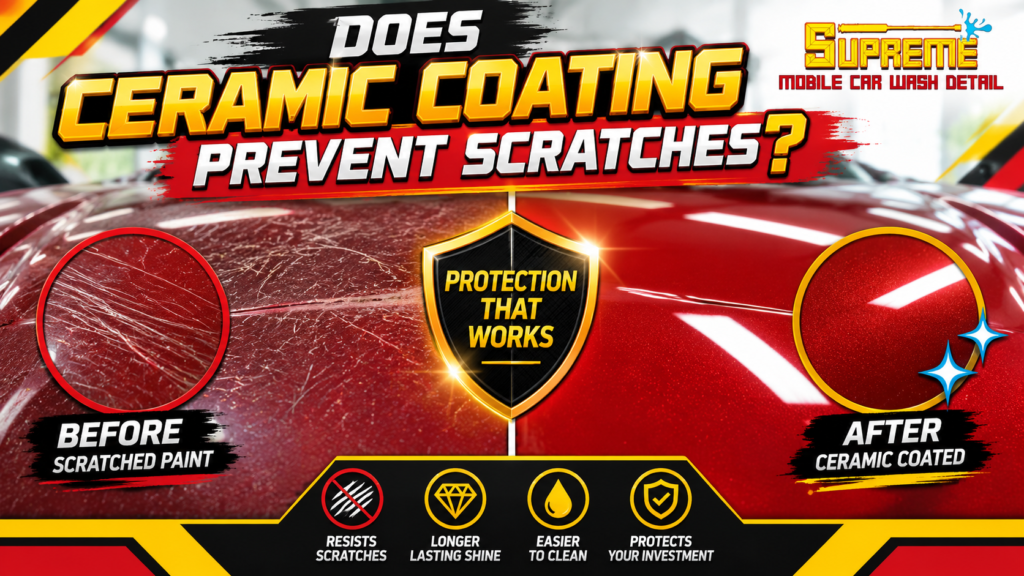
Ceramic coating can help reduce very light surface marring, but it does not make car paint scratch-proof. If you are asking, does ceramic coating prevent scratches, the accurate answer is that it adds a hard, slick protective layer that can improve resistance to minor contact and contamination, but it cannot stop damage from keys, branches, shopping carts, road debris, or improper washing. Understanding these limits helps vehicle owners choose the right paint protection and set realistic expectations before investing in a coating.
Does Ceramic Coating Protect Against Scratches?
Ceramic coating provides limited scratch resistance, not complete scratch prevention.
Once cured, a coating forms a thin protective layer over the vehicle’s clear coat. This layer can help reduce light marring caused by gentle contact, dust, washing, or drying when proper techniques are used. Its slick surface also makes dirt easier to remove, which can reduce friction during routine cleaning.
However, ceramic coating is extremely thin compared with physical paint protection products. It cannot absorb the force of deeper impacts or sharp objects. A careless wash mitt, automatic car wash brush, tree branch, or accidental scrape can still leave visible defects.
What Kind of Scratch Protection Does Ceramic Coating Provide?
The main value of ceramic coating scratch protection is resistance to minor surface damage.
Light swirls and micro-marring often develop when dirt is rubbed across paint during washing or drying. Because ceramic coatings create a smoother, hydrophobic surface, contamination tends to release more easily. That can reduce friction when the vehicle is washed correctly.
Ceramic coating may help reduce very light wash-induced marring and minor abrasion from loose contamination. It will not reliably prevent key scratches, rock chips, damage from branches, shopping cart impacts, or scratches caused by aggressive brushes and dirty towels.
This distinction matters because “scratch resistant” does not mean “scratch proof.”
How Ceramic Coating Protects Car Paint
Ceramic coating benefits extend beyond limited scratch resistance.
A properly applied automotive ceramic coating creates a hydrophobic surface that repels water and makes many contaminants easier to clean. It can also improve chemical resistance and provide a barrier between the clear coat and road grime, bird droppings, bug residue, and mineral deposits.
Ceramic coating paint protection may help maintain gloss because routine cleaning becomes easier and less aggressive. The less force required to remove contamination, the lower the chance of creating wash-related defects.
The coating itself also takes some environmental wear that would otherwise affect the clear coat directly. Over time, it can degrade and may need maintenance or reapplication.
Why Ceramic Coating Is Still Vulnerable to Scratches
Ceramic coating sits on top of the vehicle’s clear coat as a very thin layer.
Even coatings marketed with high hardness ratings should not be interpreted as armor. Hardness testing and real-world scratch resistance are not the same thing. A hard coating can still be scratched when enough pressure or friction is applied.
Fine dust dragged across a dry panel can create marks. A contaminated towel can scratch. Automated brushes can repeatedly rub debris into the paint. Ceramic coating durability helps with routine environmental exposure, but careful maintenance is still essential.
Ceramic Coating vs PPF for Scratch Protection
Ceramic coating and paint protection film serve different purposes.
Paint protection film, or PPF, is a flexible physical film installed over painted surfaces. Because it is much thicker than a ceramic coating, it can provide stronger protection against rock chips, light abrasions, and some minor impacts.
Ceramic coating is better suited to improving water behavior, gloss, chemical resistance, and ease of cleaning.
PPF may be more appropriate for high-impact areas such as the front bumper, hood, fenders, rocker panels, and mirror caps. Some owners combine PPF with ceramic coating so vulnerable areas receive physical protection while coated surfaces remain easier to maintain.
Can Ceramic Coating Prevent Swirl Marks?
Ceramic coating can reduce the likelihood of swirl marks, but washing technique still matters more.
Swirls are often created by dragging contamination across the paint. If a coated vehicle is washed with dirty brushes, rough towels, or poor technique, the coating and paint can still develop visible marks.
To reduce the risk:
- Rinse loose dirt before touching the paint.
- Use a clean wash mitt and automotive shampoo.
- Keep wheel tools separate from paint tools.
- Avoid scrubbing dry or heavily contaminated surfaces.
- Dry with clean, soft microfiber towels or filtered air.
- Avoid brush-style automatic washes when possible.
Good technique works with the coating rather than relying on the coating alone.
Ceramic Coating Limitations You Should Know
Ceramic coating offers useful protection, but it has clear limitations.
It does not repair scratches already present in the paint. Existing defects are typically addressed through paint correction before coating when appropriate.
It also does not prevent dents, stone chips, deep scratches, or every water spot. Hydrophobic surfaces can still develop mineral deposits if water dries on the paint. Bird droppings and bug residue should still be removed promptly.
A coated car also needs regular washing. Road film, minerals, and contamination can reduce water beading and make the coating appear weaker even when some protection remains.
Is Ceramic Coating Worth It for Paint Protection?
Ceramic coating can be worthwhile if you want easier maintenance, hydrophobic performance, improved chemical resistance, and an added protective layer over the clear coat.
Its value is clearer when it is viewed as part of a paint-care strategy rather than a substitute for careful ownership. Proper washing, safe drying, and timely contamination removal all help the coating perform better.
If maximum protection against physical damage is your priority, ceramic coating alone may not be enough. PPF on vulnerable areas can provide stronger protection against chips and abrasion.
Conclusion
So, does ceramic coating prevent scratches? It can help reduce very light surface marring and lower the risk of wash-related defects, but it cannot stop deep scratches, rock chips, or damage from strong physical contact. Its main strengths are easier maintenance, hydrophobic behavior, chemical resistance, and added protection for the clear coat. For drivers focused on keeping paint cleaner and easier to maintain, ceramic coating can be valuable. For stronger physical protection, especially on high-impact areas, paint protection film may be the better companion to ceramic coating.
FAQ's
No. A key can apply enough pressure to cut through ceramic coating and damage the clear coat or paint underneath. Ceramic coating is not designed to stop deep scratches.
No. Ceramic coating is scratch resistant only to a limited degree. It can help reduce light marring and make safer washing easier, but physical damage can still occur.
Ceramic coating does not remove scratches. Paint correction may reduce or remove certain defects before the coating is applied. Coating over scratched paint will not erase those marks.
Neither is universally better because they serve different purposes. Ceramic coating improves gloss, water behavior, and chemical resistance, while PPF provides stronger protection against chips and physical abrasion.

 ICONIER Digital Agency