
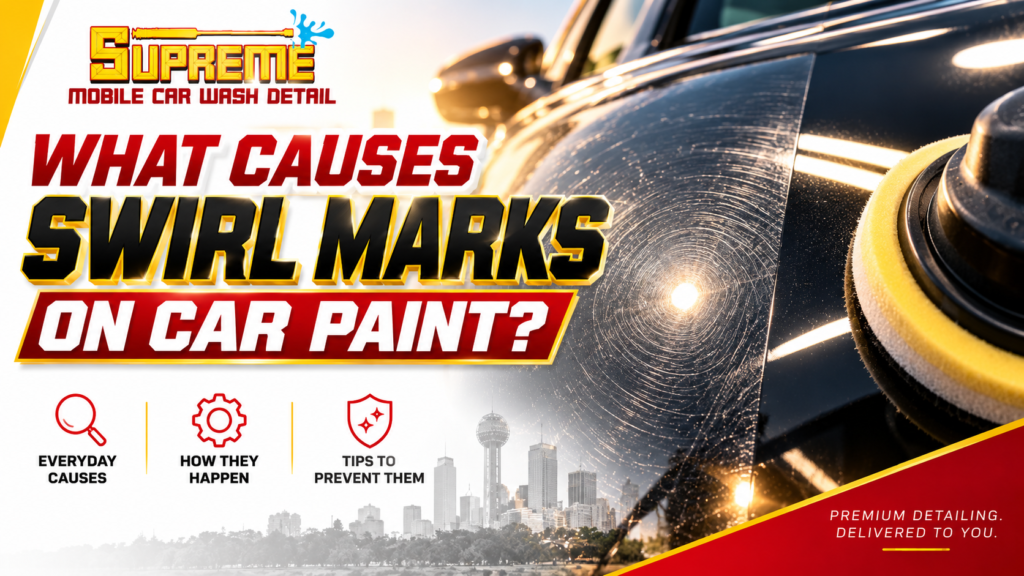
Swirl marks are fine circular or web-like scratches that become especially visible under direct sunlight or bright inspection lights. If you are wondering what causes swirl marks on car paint, the most common answer is improper washing and drying. Dirt, dust, and other particles can be dragged across the clear coat, leaving tiny scratches that reflect light in different directions. Automatic car washes, dirty towels, poor wash techniques, and improper polishing can all contribute. Understanding how swirl marks form makes it easier to prevent them and choose the right method for removing them.
What Causes Swirl Marks on Car Paint?
Swirl marks are usually caused by repeated light abrasion against the vehicle’s clear coat. They are not truly circular in most cases. Instead, they are many fine scratches running in different directions that appear circular when light reflects across the paint.
Common causes include:
- Washing without enough lubrication
- Using contaminated wash mitts or towels
- Dry wiping dusty paint
- Brush-style automatic car washes
- Drying with rough or dirty towels
- Improper machine polishing
Dark-colored vehicles often show car paint swirl marks more clearly, but the damage can occur on any paint color.
How Swirl Marks Form During Washing
Washing is one of the biggest sources of micro scratches on car paint. Dirt on the surface contains small abrasive particles. If those particles are rubbed across the clear coat, they can leave fine scratches behind.
Washing Without Proper Pre-Rinsing
Touching a heavily contaminated vehicle before removing loose dirt increases the risk of scratching. A thorough rinse helps remove dust, sand, and road debris before a wash mitt contacts the paint.
Using automotive shampoo also provides lubrication between the wash media and paint. Washing with too little lubrication or allowing the surface to dry can increase friction.
Using Dirty Wash Mitts or Towels
A microfiber mitt can become contaminated as it collects dirt. Continuing to use it across multiple panels can drag that contamination over the paint.
The same problem can happen during drying. A towel containing grit or hardened residue may leave fine scratches even after a careful wash. Keeping wash tools clean is essential for preventing swirl marks.
Can Automatic Car Washes Cause Swirl Marks?
Yes, some automatic car washes can contribute to swirl marks, especially systems that use rotating brushes or cloth strips that contact the paint.
The problem is repeated physical contact. Brushes or cloth may also carry contamination that can be rubbed across the surface.
Over time, repeated visits can increase visible marring, particularly on dark or soft clear coats.
Touchless washes reduce direct contact, but they may rely on stronger chemicals and may not remove every contaminant. Careful hand washing is generally better for minimizing wash-induced scratches.
Other Common Causes of Car Paint Swirl Marks
Improper washing is not the only cause. Everyday habits can create similar defects.
Dry wiping is a common example. Using a towel to remove dust from dry paint may seem harmless, but dust particles can act like fine abrasives.
Improper waxing or polishing can also create marks. A dirty applicator, excessive pressure, or incorrect machine polishing can leave haze or additional scratches.
Car covers can contribute if dirt becomes trapped between the cover and paint. Wind movement may then cause the contaminated fabric to rub against the surface.
How to Prevent Swirl Marks on Car Paint
Preventing swirl marks is easier than correcting them later. The goal is to reduce friction and keep abrasive contamination away from the paint.
A safer washing routine includes:
- Rinse the vehicle thoroughly before touching it.
- Use a pH-balanced automotive shampoo.
- Wash with a clean microfiber mitt.
- Clean the mitt frequently during the wash.
- Keep wheel tools separate from paint tools.
- Avoid aggressively scrubbing stubborn contamination.
- Dry with clean, soft microfiber towels or filtered air.
- Never wipe dusty paint while it is dry.
Consistent washing technique is one of the most effective ways to reduce new defects.
How to Remove Swirl Marks
Swirl mark removal usually requires paint correction rather than simply covering the marks with wax.
Paint correction uses polishing compounds and machine polishers to level a very small amount of clear coat around the defects. This reduces the appearance of scratches and restores clarity and gloss.
The exact approach depends on defect depth, paint hardness, clear coat condition, and previous polishing history.
Polishing Swirl Marks Safely
Not every vehicle needs aggressive correction. Light swirl marks may respond to a mild polish, while deeper defects can require a more involved process.
Because polishing removes a small amount of clear coat, it should be controlled. Using the least aggressive combination that achieves the desired improvement helps preserve the finish.
Deep scratches that extend beyond the clear coat may not be safely removable through polishing alone.
Does Ceramic Coating Prevent Swirl Marks?
Ceramic coating can help reduce the risk of light wash-induced marring, but it does not make paint scratch-proof.
A coating creates a slick, hydrophobic surface that can make dirt easier to remove. This may reduce friction during washing and drying.
Poor techniques can still scratch a coated vehicle. Dirty brushes, contaminated towels, and abrasive particles can damage the coating and potentially mark the paint underneath.
Ceramic coating can support safer maintenance, but proper washing remains essential.
Paint Protection After Swirl Mark Removal
Once swirl marks have been corrected, paint protection can help preserve the finish.
Wax, sealants, ceramic coatings, and paint protection film serve different purposes. Wax and sealants provide surface protection, ceramic coatings offer longer-lasting hydrophobic and chemical resistance, and paint protection film adds a physical barrier against some abrasion and impact.
No product eliminates the need for careful washing. The best paint protection from swirl marks combines appropriate protection with good maintenance habits.
Conclusion
Understanding what causes swirl marks on car paint makes prevention much easier. Most swirl marks come from repeated light abrasion caused by poor washing, contaminated towels, automatic brushes, dry wiping, or improper polishing. Safe washing techniques, clean microfiber tools, good lubrication, and gentle drying can help protect the clear coat. If swirl marks are already present, paint correction may restore gloss by carefully polishing the affected surface. Ceramic coatings and other protective products can support long-term paint care, but consistent maintenance remains the strongest defense against new swirl marks.
FAQ's
Not always. Many light swirl marks are limited to the clear coat and can often be reduced or removed through polishing. Deeper scratches may require more advanced repair.
Dark paint creates stronger contrast when light reflects from fine scratches, making swirl marks easier to see. Similar defects can still exist on lighter colors.
Wax may temporarily hide very fine defects by filling them, but it does not permanently remove scratches. Proper swirl mark removal generally requires polishing or paint correction.
Yes, if they are dirty, damaged, or used with excessive pressure. Clean, soft microfiber towels are much safer when used correctly.

 ICONIER Digital Agency